 Twitter @CharterPrimary

At Charter we aim to develop the full potential of all of our pupils as confident, literate readers and writers. Here at Charter, we use Read, Write Inc. (RWI) for the systematic teaching of phonics. We aim to teach the children to read fluently and accurately and develop skills which promote understanding and interpretation of texts to support the curriculum.
Here we have put together a guide to how the RWI programme works, together with some useful links. Please take the time to read this as it will provide invaluable information as to how you can help and support your child at home.
Read Write Inc (RWI) is a phonics programme which helps all children learn to read fluently and at speed so they can focus on developing their skills in comprehension, vocabulary and spelling.
This is a full teaching programme proven to develop:
- Confident speakers,
- Fluent and enthusiastic readers,
- Keen writers
Children are taught to:
- Learn to read and write letter sound correspondences quickly
- Decode effortlessly
- Spell and handwrite easily
- Read with fluency and expression
- Comprehend what they read
- Write confidently using oral rehearsal
- Work effectively with a partner to articulate their learning at every step.
All Reception and Key Stage One staff have been trained to deliver this synthetic phonic programme.
Reception
In Reception all children will learn how to ‘read’ the sounds in words and how these sounds can be written down.
Reading
The children:
- learn 44 sounds and the corresponding letters/letter groups using simple picture prompts – see below
- learn to read words using Fred talk and sound blending
- read from a range of storybooks and non-fictions books matched to their phonic knowledge
- work well with partners
- develop comprehension skills in stories by answering ‘Find It’ and ‘Prove It’ discussion questions
Writing
The children:
- learn to write and form the letters/letter groups which represent the 44 sounds with the help of fun phrases
- learn to write words by using Fred Talk
- learn to build sentences by practising sentences out loud before they write
Talking
The children work in pairs so that they can:
- answer every question
- practise every activity with their learning partner
- take turns in talking and reading to each other
- develop ambitious vocabulary
Year One & Year Two
Children follow the same format as Reception but will work on more complex sounds and will read books appropriate to their reading level. Daily sessions of RWI phonics last for 30 minutes. Once children become fluent speedy readers and can use and apply Set 1, 2 and 3 sounds confidently they focus on spelling, grammar and punctuation sessions in Year 2.
All children are assessed regularly by our RWI lead teacher, Mrs Weston. Your child will be assessed each term to ensure they are grouped correctly for their phonics and that they are receiving the correct support and level of challenge for their needs.
Here are the five key principles that underpin the teaching in all of our Read Write Inc. sessions:
Purpose – We know the purpose of every activity and share it with the children.
Participation – We ensure every child participates throughout the lesson. Partnership work is fundamental to their learning.
Praise – We ensure children are praised regularly for their effort and learning.
Pace – We teach at an effective pace and devote every moment within our phonics sessions to the teaching and learning of reading skills.
Passion – We are passionate about teaching so children are engaged and eager during our phonics sessions.
 We use pure sounds (‘m’ not’ muh’,’s’ not ‘suh’, etc.) so that your child will be able to blend the sounds into words more easily.
In class we use a frog puppet called Fred who is an expert on sounding out words and he can only talk to us in sounds. We call this, ‘Fred Talk’. E.g. m-o-p, c-a-t, m-a-n, sh-o-p, b-l-a-ck.
The following video is an example of blending sounds with Fred.
https://www.youtube.com/watch?v=dEzfpod5w_Q
The children are taught the sounds in 3 sets.
Set 1 Sounds are taught in the following order together with rhymes to help children form the letters correctly and instantly recognise sounds ready for blending.
| Set 1 | |
| Sound | Rhyme |
| m | Down Maisie then over the two mountains. Maisie, mountain, mountain. |
| a | Round the apple, down the leaf. |
| s | Slide around the snake |
| d | Round the dinosaur’s back, up his neck and down to his feet. |
| t | Down the tower, across the tower, |
| i | Down the insects body, dot for the head. |
| n | Down Nobby and over the net. |
| p | Down the plait, up and over the pirates face. |
| g | Round the girls face, down her hair and give her a curl |
| o | All around the orange |
| c | Curl around the caterpillar |
| k | Down the kangaroos body, tail and leg |
| u | Down and under the umbrella, up to the top and down to the puddle |
| b | Down the laces, over the toe and touch the heel |
| f | Down the stem and draw the leaves |
| e | Slice into the egg, go over the top, then under the egg |
| l | Down the long leg |
| h | Down the horse’s head to the hooves and over his back |
| sh | Slither down the snake, then down the horse’s head to the hooves and over his back |
| r | Down the robot’s back, then up and curl |
| j | Down his body, curl and dot |
| v | Down a wing, up a wing |
| y | Down a horn, up a horn and under the yak’s head. |
| w | Down, up, down, up the worm. |
| th | Down the tower, across the tower, then down the horse’s head to the hooves and over his back |
| z | Zig-zag-zig, down the zip. |
| ch | Curl around the caterpillar, , then down the horse’s head to the hooves and over his back |
| qu | Round the queen’s head, up to her crown, down her hair and curl |
| x | Cross down the arm and leg and cross the other way |
| ng | A thing on a string |
| nk | I think I stink |
We do not use letter names at this early stage.
Children also use pictures for each sound to help recognise the sound and then form the shape of each sound.
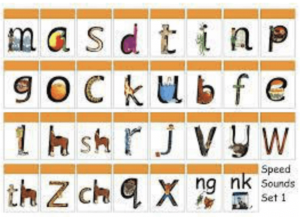
The children are then taught Set 2 Sounds – the long vowels. When they are very confident with all of set 1 and 2 they are taught Set 3 Sounds.
| Long vowel sound | Set 2 Speed Sound cards | Set 3 Speed Sound cards | |
| ay | ay: may I play | a-e: make a cake | ai: snail in the rain |
| ee | ee: what can you see | ea: cup of tea | e: he me we she be |
| igh | igh: fly high | i-e: nice smile | |
| ow | ow: blow the snow | o-e: phone home | ao: goat in a boat |
| oo | oo: poo at the zoo | u-e: huge brute | ew: chew the stew |
| oo | oo: look at a book | ||
| ar | ar: start the car | ||
| or | or: shut the door | aw: yawn at dawn | |
| air | air: that’s not fair | are: share and care | |
| ir | ir: whirl and twirl | ur: nurse for a purse | er: a better letter |
| ou | ou: shout it out | ow: brown cow | |
| oy | oy: toy for a boy | oi: spoil the boy | |
| ire | ire: fire fire! | ||
| ear | ear: hear with your ear | ||
| ure | ure: sure it’s pure? | ||
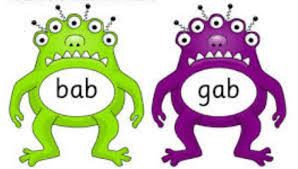 As well as learning to read and blend real words children will have plenty of opportunities to apply their sound recognition skills on reading ‘Nonsense words’. These words will also feature heavily in the Year One Phonics Screening check in the summer term.
Children are introduced to ‘Ditty books’ when they successfully begin to read single words. The short vowels should be kept short and sharp.
Children use sound-blending (Fred Talk) to read short ditties. Children will then be challenged to use their developing phonic knowledge to write short sentences in their writing sessions.
Within all the books children will have red and green words to learn to help them to become speedy. Red words are words that are not easily decodable and challenge words to extend children’s vocabulary. Green words are linked to the sounds they have been learning and are easily decodable.
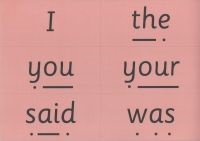
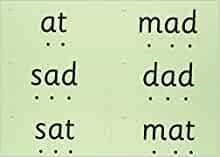
Dots and dashes represent the sound each letter makes.
During the RWI session children will read the book three times and at each new reading they will have plenty of opportunities to practise using their developing comprehension skills.
We aim for the children to follow the order of books listed below. The expectation is that all children will leave KS1 as confident speedy readers, ready to take on the challenges of KS2. However, some children may need extra support and we ensure targeted intervention sessions are in place in the afternoons.
Book Order:
Sound Blending Books 1 – 10
Red Ditty Books 1 – 10
Green Books 1 – 10
Purple Books 1 – 10
Pink Books 1 – 10
Orange Books 1 – 12
Yellow Books 1 – 10
Blue Books 1 – 10
Grey Books 1 – 13
Any pupil who is not making expected progress receives additional support and intervention through Read, Write Inc. intervention sessions to suit the child’s needs. If you have any questions or concerns about RWI and your child’s progress, please see your class teacher or Mrs Weston, our Read Write Inc. lead teacher.
During daily sessions of phonics there are opportunities for practitioners to regularly assess children’s understanding of letter-sound correspondences. Outside the discrete daily phonics sessions there are opportunities to observe the application of phonics skills e.g. during story time, preparing for lunch etc. During each Read, Write Inc. phase there are judgements to determine if a child is secure at each level.
Every term, our RWI Reading Leader moderates pupil assessments using the RWI assessment documents and phonics groupings are regularly reviewed so that pupils can move fluidly between groups depending on their rates of progress.
What is the Year 1 phonics screening check?
The Year 1 phonics screening check is a short, light-touch assessment to confirm whether individual pupils have learnt phonic decoding to an appropriate standard. It will identify the children who need extra help so they are given support by their school to improve their reading skills. They will then be able to retake the check so that schools can track pupils until they are able to decode fluently and confidently.
Further information on the phonics screening check can be found by clicking here.
Please click on the links below for further information.
There are lots of ways you can help your child learn phonics too. Click here to found out more about the Read Write Inc Phonics scheme including helpful videos and resources to support your child at home. Further information can also be found at Oxford Owl site, please click here.
Phonics Play and ICT Games also gives you advice and offers fun, interactive games for children to play.
If you have any additional questions please call in and speak to your child’s class teacher.